AAIC 2026: Where Alzheimer’s Prevention, Treatment, and Diagnosis Stand Now

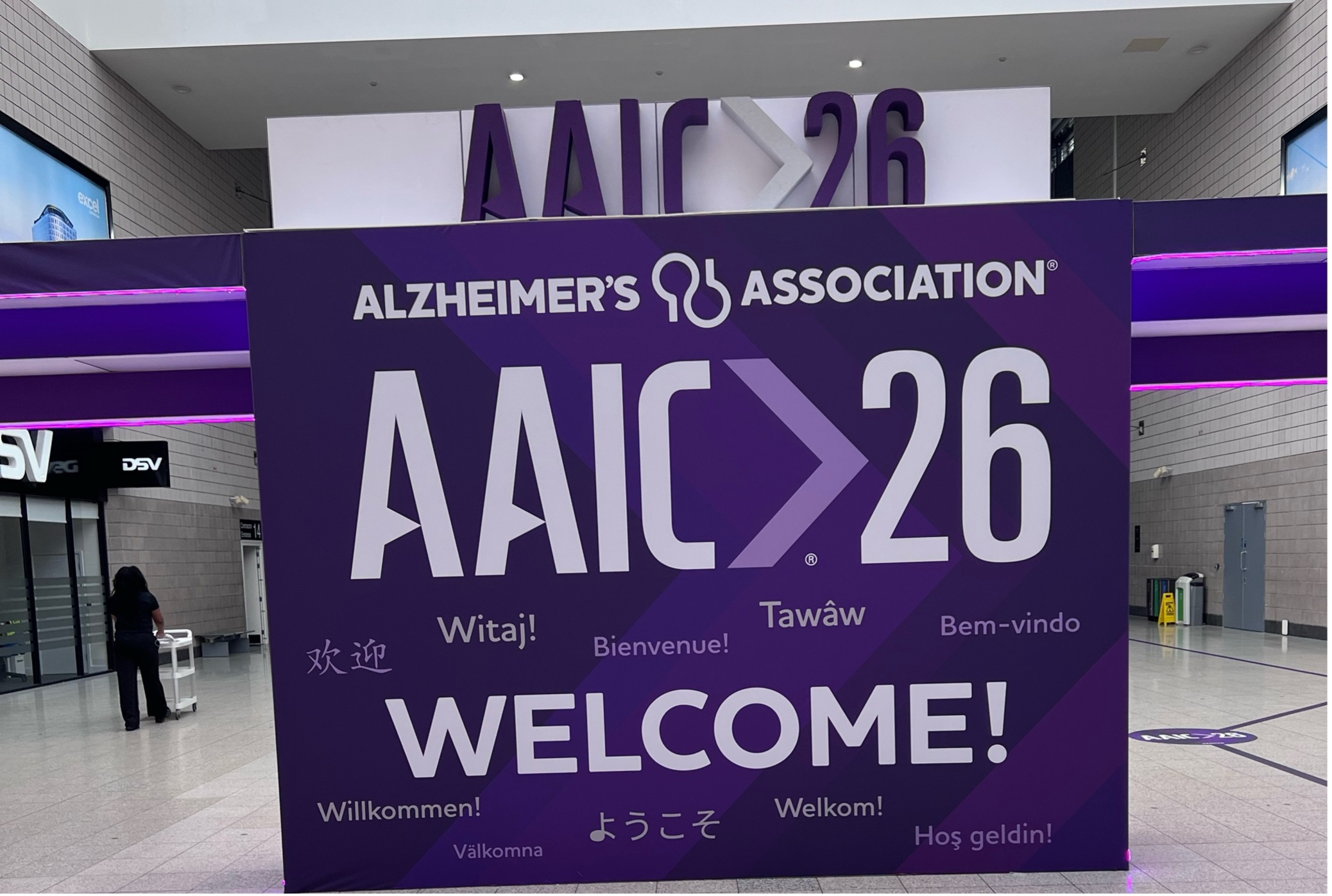
The Alzheimer’s Association International Conference (AAIC) 2026 offered one of the clearest snapshots yet of a field moving on three fronts at once: preventing decline through lifestyle, altering the disease course with drugs, and diagnosing pathology from a simple blood draw. For our group — with its long-standing interest in brain health, cognitive-decline biomarkers, and digital health — these were the developments worth reporting. Here is what stood out.
Lifestyle as therapy: from FINGER to PROTECT-Cog
The prevention story rests on a simple epidemiological observation, crystallised by the Lancet Commission on dementia: a large share of dementia cases — on the order of 40%, and higher in some populations — is attributable to modifiable risk factors such as physical inactivity, hypertension, diabetes, obesity, smoking, low cognitive engagement, social isolation, hearing loss, and depression.
Because Alzheimer’s is multifactorial, single-domain interventions (exercise alone, one nutrient alone, cognitive training alone) had mostly produced weak or null effects. The FINGER trial (Finland, 2015) tested the opposite hypothesis: intervene on the whole risk profile at once — exercise, nutrition, cognitive training, and vascular/metabolic monitoring, plus social engagement. It became the first randomised controlled trial to show that a structured, simultaneous, multidomain programme measurably protects cognition in at-risk but still-healthy older adults, compared against general health advice. Everything downstream is built on that result.
The obvious question was whether FINGER travels. U.S. POINTER took the model into a large, ethnically and geographically diverse American population, delivered through real-world community infrastructure. Its design also sharpened the question — instead of a pure control group it compared a structured intervention against a self-guided one, so it can speak to the added value of structure and coaching rather than the absolute effect of lifestyle change. The message: structure and accountability matter. At AAIC 2026, LatAm-FINGERS extended the paradigm into Latin American countries, and the broader World-Wide FINGERS network continues to carry it globally.
The most striking announcement came on 13 July: PROTECT-Cog, a roughly \$100 million global trial launched by the Alzheimer’s Association. It pairs a proven multidomain lifestyle programme with a GLP-1 receptor agonist (the semaglutide class) to test whether drug plus lifestyle can reduce the risk of cognitive decline, MCI, and dementia in at-risk older adults. The rationale draws on real-world datasets suggesting GLP-1 drugs may lower dementia risk substantially versus other diabetes medications — strongest in people with obesity — alongside mechanistic links to brain inflammation, metabolism, and vascular health. Its significance is conceptual: no drug has ever been proven to prevent dementia. Notably, standalone semaglutide failed to slow established Alzheimer’s in the EVOKE trials, so PROTECT-Cog asks whether the same class works better earlier and in combination. Results are years away.
Disease-modifying drugs: anti-amyloid matures, tau enters the stage
The two approved anti-amyloid antibodies — the only drugs that alter the disease course rather than merely easing symptoms — are now embedded in practice. Lecanemab (Leqembi) slows decline by around 27%, received full FDA approval in July 2023, gained European approval in April 2025 (with ApoE4 limitations), and now offers a weekly subcutaneous self-injection option. Donanemab (Kisunla) slows decline by around 35%, was FDA-approved in July 2024 and approved in Europe in April 2026 (again with ApoE4 limitations), and uses a “treat-to-clear” approach that stops once amyloid is cleared. Both are for early-stage disease with confirmed amyloid, both require MRI monitoring for ARIA.
With authorisation comes the need for real-world evidence, gathered through registries such as the U.S. flagship ALZ-NET. Two themes dominated the discussion: whether real-world efficacy and safety match the pivotal Phase III trials (Clarity AD for lecanemab, TRAILBLAZER-ALZ2 for donanemab), and whether the initially restrictive eligibility criteria should be reconsidered, given how many candidate patients they exclude.
The paradigm is also being pushed earlier. The AHEAD 3-45 study tests whether lecanemab given to cognitively normal people with accumulating amyloid can prevent or delay Alzheimer’s — secondary prevention during the silent preclinical phase. Its donanemab counterpart, TRAILBLAZER-ALZ 3, used a plasma p-tau217 blood test and a decentralised design to screen more than 63,000 people down to around 2,196 enrolled, with a time-to-progression endpoint. Both are ongoing, with no efficacy results yet.
The genuine headline, though, was a move beyond amyloid. In the Phase 2 CELIA trial, Biogen’s diranersen (BIIB080) — an antisense oligonucleotide discovered by Ionis that silences tau mRNA — slowed clinical decline by 26% on the CDR-SB at its 60-mg dose and produced what the company called “unprecedented” tau reductions, with 50–65% drops in CSF total tau and reductions in brain tau on PET. Widely described as the hottest ticket at the conference, it was framed as the first real signal that the field can extend disease modification beyond amyloid to tau.
A blood test for Alzheimer’s: p-tau217 comes of age
Perhaps the most consequential shift for everyday clinical care is diagnostic. p-tau217, measured from ordinary venous blood, has broken away from every other blood marker because its performance is comparable to amyloid PET in some settings, backed by a large body of validation (the SEABIRD and SUNBIRD studies being flagships). If a blood test can stand in for a PET scan or a lumbar puncture, diagnosis becomes cheaper, non-invasive, and scalable into ordinary clinical settings — transformative for a disease where confirming pathology has historically meant expensive imaging or a spinal tap.
Translation has been remarkably fast. In May 2025 the FDA cleared the first Alzheimer’s blood test (Fujirebio’s Lumipulse G p-tau217/β-amyloid 1-42 plasma ratio) for symptomatic adults 55+ in specialty care. In October 2025, Roche’s Elecsys pTau181 became the first blood biomarker cleared for the primary-care setting as a rule-out tool, with a very high negative predictive value that can spare many people unnecessary PET or CSF testing. By May 2026, Roche had received a European CE mark for a more advanced Elecsys pTau217 test positioned as a standalone rule-in/rule-out tool comparable to PET, with further data presented at AAIC.
Two cautions were emphatic and worth repeating. These tests are for symptomatic people, not for screening the healthy — the Alzheimer’s Association explicitly does not recommend blood biomarker testing in asymptomatic individuals, because we cannot yet reliably say who will progress or when. And a positive test detects pathology, not “Alzheimer’s the disease”: it is one input to a clinical evaluation, not a verdict on severity or symptoms.
What it adds up to
AAIC 2026 sketched a coherent trajectory. Prevention is graduating from lifestyle alone to lifestyle combined with metabolic drugs; treatment is maturing on amyloid and, for the first time, showing credible movement on tau; and diagnosis is migrating from the imaging suite to the blood draw — with clear guardrails about who should and should not be tested. For a field long defined by disappointment, the direction of travel is unmistakable, and the emphasis on early, combined, and accessible runs through all of it.