Published! Data-driven clinical decision trees and generative topographic mapping to guide stroke rehabilitation program allocation [PLOS ONE]

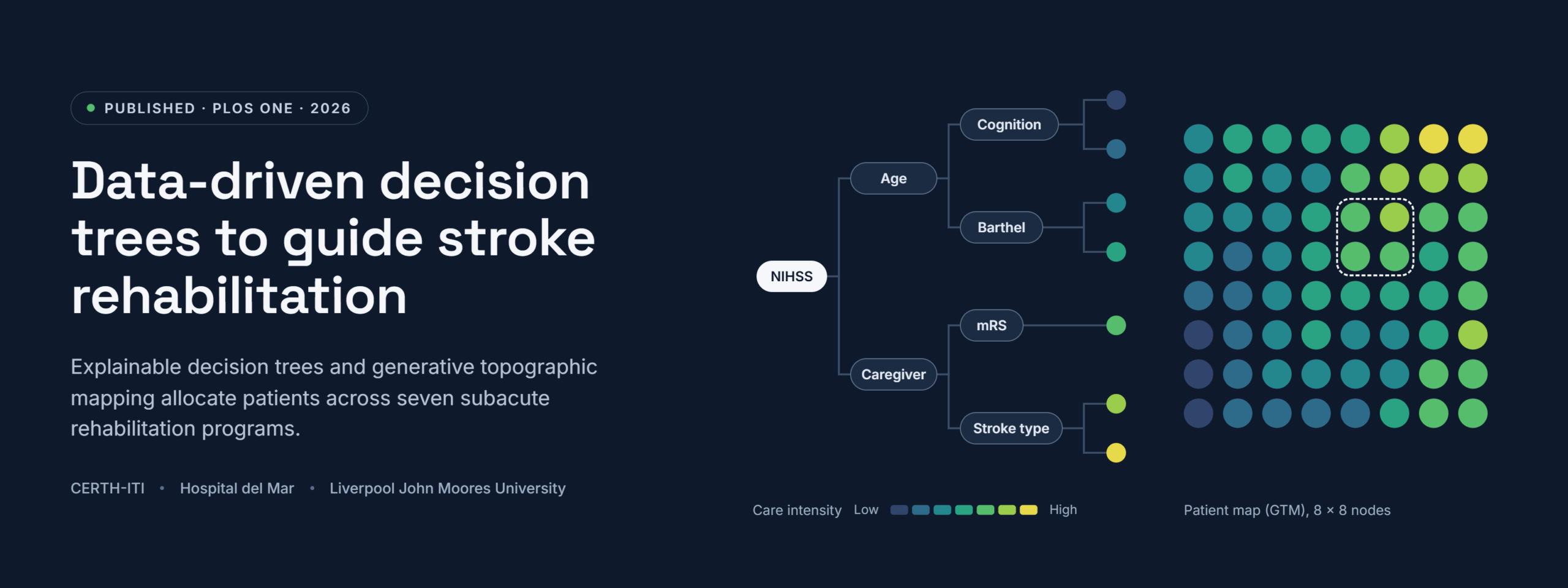
Our latest publication in Plos One presents a transparent, data-driven framework to help clinicians decide where a patient should continue their rehabilitation after a stroke. Using an openly shared, expert-annotated dataset, we built machine learning models and short, readable decision trees that allocate patients across seven subacute rehabilitation programs. We then used Generative Topographic Mapping (GTM) to show, on a single map, where the models agree with clinicians and where they do not.
The Challenge
Choosing the right rehabilitation setting after stroke shapes both a patient’s recovery and how health-system resources are used. Yet most triage tools in use today are empirical, rely on a handful of variables, and sort patients into just two destinations, typically home or not home. In practice, clinicians choose among many more options, from no hospitalization at all to high-intensity, complex inpatient care.
What We Did
- A realistic synthetic cohort. We simulated 700 stroke patients described by 49 clinical variables, sampled from distributions reported in the literature (e.g., NIHSS, age, comorbidities, MoCA, mRS, Barthel, FIM, and the likelihood of seizures, aphasia and dysphagia).
- Expert labels. Four attending physicians at Hospital del Mar in Barcelona assigned every patient to one of seven subacute rehabilitation programs.
- Predictive models. We compared six classifiers (multinomial logistic regression, KNN, SVM, random forest, XGBoost and LDA) using the ten most informative predictors, evaluated over 200 repetitions of stratified 10-fold cross-validation.
- Readable decision trees. We built shallow Classification and Regression Trees (CART) that a clinician can follow step by step, and benchmarked everything against the in-house decision tree currently used at Hospital del Mar.
- A visual map of patient phenotypes. GTM projected all patients onto a two-dimensional map, letting us overlay the recommendations of clinicians, the in-house tree and XGBoost and see exactly where they diverge.
Key Findings
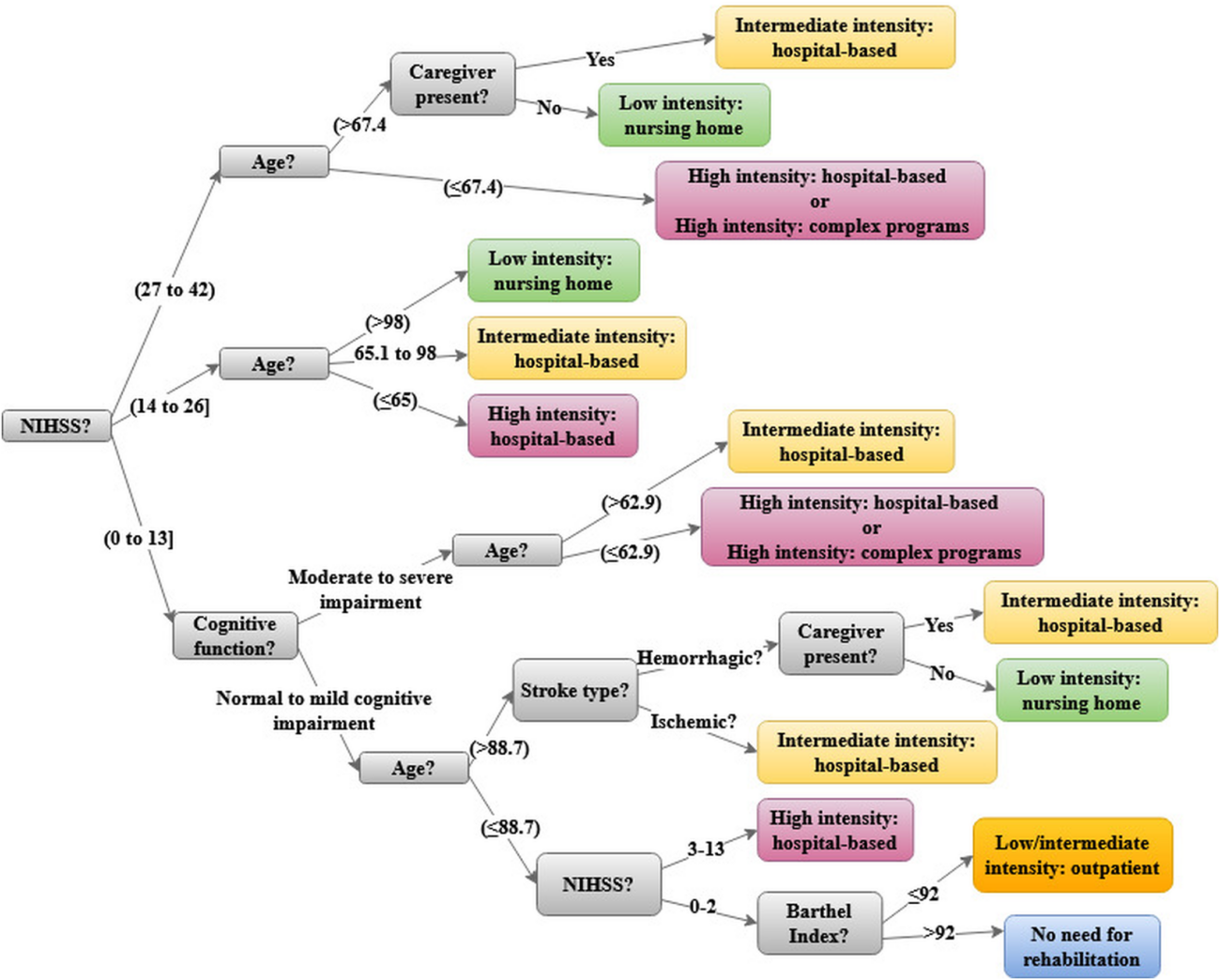
- A five-level decision tree matched clinician allocations in about 85% of cases, outperforming the in-house tree currently in use (75%).
- What drives the decision. Cognitive status, stroke severity (NIHSS), age, early seizures, alcohol use, stroke type, caregiver presence, smoking, Barthel index and mRS were the ten most influential predictors.
- How the tree reasons. Stroke severity comes first, with NIHSS cut-offs near 13 and 26, followed by age, caregiver presence, cognition and functional independence. Younger patients tend to be routed to more intensive programs.
- Where the tools disagree. On the GTM map, the in-house tree sent more patients to intermediate care than clinicians did, while XGBoost tracked the clinicians more closely. These regions of disagreement point to the patient profiles most worth reviewing.
- An imbalanced reality. Two programs, intermediate (56%) and high-intensity (37%) hospital-based care, covered most patients, while some programs had only 1 to 8 patients. This is why balanced accuracy stays low across all models.
Why This Matters
Shallow decision trees offer a rare combination: accuracy comparable to black-box models, with logic that fits on a single page. Clinicians can inspect, question and adapt each split, which is essential for trust and for local adoption. GTM adds a second layer of transparency, turning model-versus-clinician disagreement into a visual map that care teams can discuss. Together, they provide an open, reproducible starting point that hospitals can tailor to their own patients, programs and resources.
Open Data
The annotated dataset and the in-house decision tree are openly available on figshare, so other groups can reproduce our results or build their own allocation tools.
Funding
This work was made possible through the support of the TARGET EU Project (https://target-horizon.eu/) and the inspiring team at the Centre for Research & Technology Hellas (CERTH), Hospital del Mar, and Liverpool John Moores University.
Read the full Paper
Komaris D-S, Anagnostou P, Nikolopoulos S, Tsaopoulos D, Guillen-Sola A, Duarte E, Bellfield RAA, Ortega-Martorell S, Olier I, Kompatsiaris I. Data-driven clinical decision trees and generative topographic mapping to guide stroke rehabilitation program allocation. PLOS ONE 21(11): e0363251 (2026). Read the paper in Plos One.